Long-Form Project Synopsis
FERN — Farming Ecosystem & Resource Network
AURA — Agricultural Utility & Reasoning Assistant
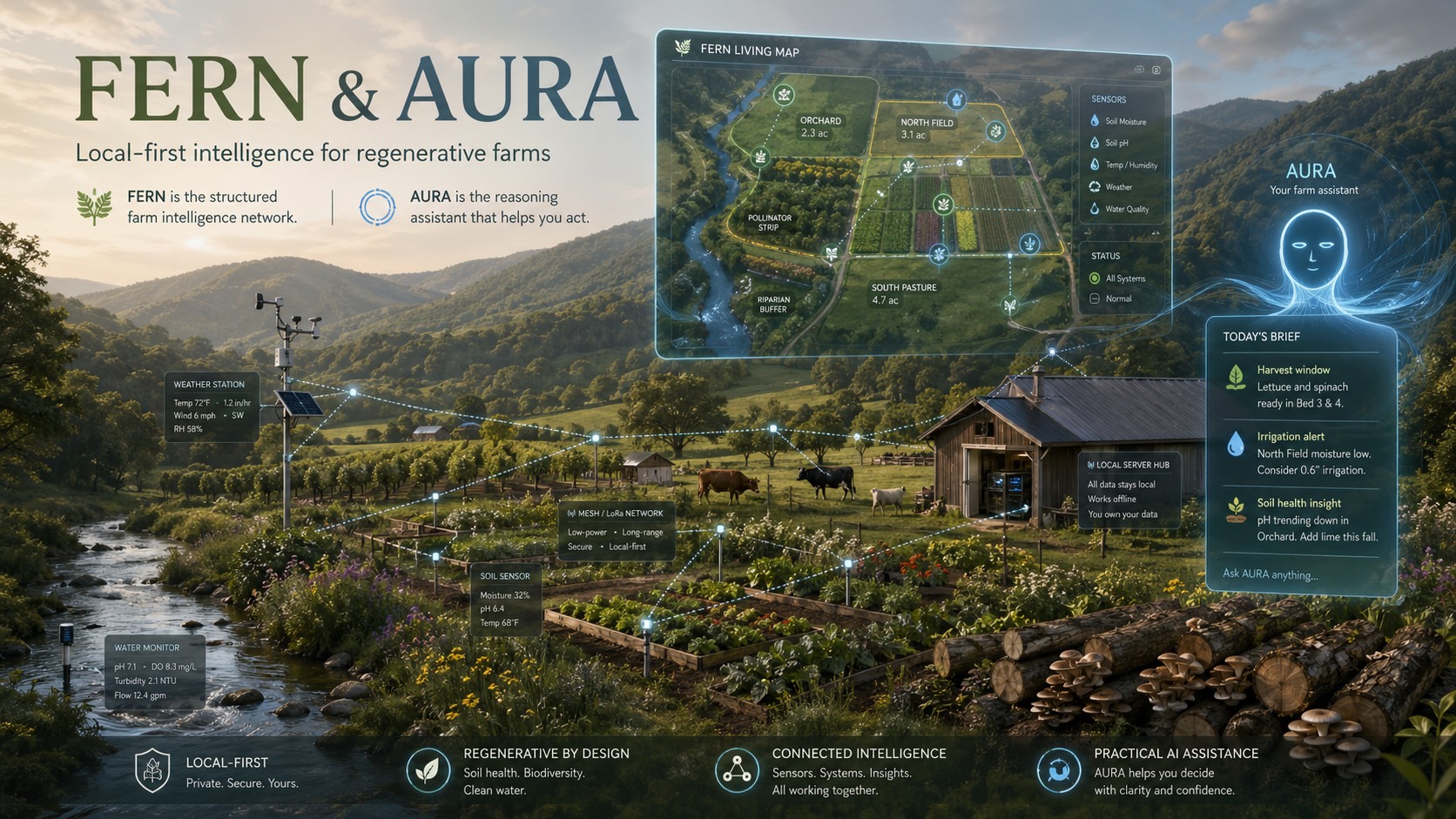
FERN and AURA are the foundation of a local-first, farmer-owned agricultural operating system designed to help farms make better decisions, reduce preventable losses, improve long-term land health, and strengthen local food systems.
At the highest level, FERN is the structured intelligence layer: the farm database, the sensor network, the environmental model, the plant knowledge system, and the historical memory of what is happening on a specific piece of land. AURA is the reasoning layer that interprets all of that information and turns it into practical guidance, recommendations, alerts, and eventually deeper strategic assistance across operations, planning, finances, and network coordination.
The core idea is simple: most farms are forced to operate with partial information, scattered tools, and constant uncertainty. A farmer has to be agronomist, mechanic, business manager, weather analyst, marketer, labor planner, and bookkeeper all at once. FERN and AURA are meant to reduce that burden by giving the farmer a system that helps them see what is happening, understand why it matters, and act before small problems become expensive ones.
This is not built around the idea of replacing the farmer. It is built around augmenting the farmer. Experience still matters. Observation still matters. Judgment still matters. But the system becomes a second set of eyes, a memory bank, a planner, a monitor, and eventually a full decision-support framework for the entire farm.
1. The Mission
The deeper mission behind FERN and AURA is bigger than farm automation.
The modern food system has become dependent on long supply chains, extractive production methods, centralized buyers, generic input-heavy practices, and a model that often leaves farmers sitting on a razor’s edge financially. Food is shipped long distances, quality drops, waste rises, soil degrades, and smaller diversified farms are pushed to compete in a system designed around scale, uniformity, and commodity logic.
FERN and AURA aim to help reverse that trend by giving smaller and mid-sized farms access to tools that are usually either unavailable, unaffordable, or poorly designed for their reality. The goal is to make local and regenerative farming more viable, more profitable, and more resilient without forcing farmers into another subscription trap or closed ecosystem.
The long-term mission is to improve farms, improve land, improve local food access, and strengthen communities by rebuilding agricultural intelligence from the ground up.
2. Core Philosophy
Local-first
The system is designed to run primarily on hardware owned by the farmer. Core functions should not depend on constant internet access. The farmer owns the system, owns the data, and maintains core functionality whether or not they ever connect to a cloud layer.
Farmer-owned
This is intentionally the opposite of the “you’re renting your tools forever” model. The farm should continue operating if the farmer never pays another dollar after setup. Optional updates, add-ons, and network services can exist, but the core system should remain usable indefinitely.
Decision-first, not dashboard-first
Many ag systems collect data. FERN and AURA are built to turn data into action. The goal is not to drown the farmer in numbers. The goal is to tell them what matters, where it matters, and what to do next.
Regenerative by design
The system should not just optimize yields in the short term. It should help minimize unnecessary inputs, improve soil over time, support companion planting and ecological relationships, and encourage land stewardship instead of depletion.
Modular and expandable
FERN and AURA are designed to grow over time. The first useful version can be relatively simple. The long-term system can expand into planning, business operations, market coordination, security, ecology mapping, and much more.
3. What the System Is in Its Most Basic Form
At its simplest, FERN and AURA are a local-first farm decision system.
A farmer installs a small on-farm server and a set of sensors across key areas. The system takes in sensor data, external weather data, and manual farm inputs. FERN structures and stores that information as a model of the specific farm. AURA interprets conditions and produces practical outputs: alerts, recommendations, daily briefs, planning suggestions, and later more advanced strategic guidance.
The key loop is:
Input → Understand → Decide → Alert → Act → Learn → Improve
That loop is the core product.
Everything else grows from that.
4. Core Technical Architecture
A. Farm Inputs
FERN begins with three broad input categories:
1. Sensor data
This can include:
-
Soil moisture
-
Soil pH
-
NPK or other nutrient indicators
-
Light levels
-
Temperature
-
Humidity
-
Water levels
-
Microclimate conditions
-
Weather station inputs
-
Additional future environmental sensors
The long-term vision includes robust field sensing designed specifically for diverse farms rather than just large monocrop operations.
2. User input
The farmer can enter:
-
What crops are planted and where
-
Notes and observations
-
Problems noticed in the field
-
Harvest timing
-
Input usage
-
Cost data
-
Custom farm layout and zone definitions
-
Livestock details
-
Operational notes
3. External data
This can include:
-
Local weather forecasts
-
Historical climate trends
-
Market information
-
Regional conditions
-
Optional shared learning from other farms
-
Buyer demand signals
B. FERN Data Layer
FERN is the structured intelligence layer of the system. It stores the farm as an organized, evolving model rather than a loose pile of readings.
FERN includes:
-
Farm zones and maps
-
Crop locations
-
Soil conditions by area
-
Historical sensor readings
-
Plant data
-
Companion planting relationships
-
Input history
-
Yield history
-
Operational history
-
Seasonal patterns
-
Future business and network data
FERN is not just a logbook. It is the memory and structure of the farm.
C. AURA Decision Engine
AURA interprets what is happening on the farm and turns it into usable guidance.
It combines:
-
Current sensor data
-
Historical data
-
Crop-specific needs
-
Farm layout
-
Plant compatibility and environmental tolerance
-
Weather inputs
-
User feedback
-
Long-term learning about a specific farm
AURA’s job is not to blindly automate everything. Its job is to reason about the system and surface what matters in a practical way.
5. Immediate Functional Capabilities
In its first meaningful form, FERN and AURA should already be able to deliver serious value.
Real-time condition awareness
The system monitors what is happening across the farm and gives the farmer visibility into conditions they would otherwise have to manually check.
Daily briefings
AURA can generate a daily morning brief showing:
-
What needs attention
-
What is at risk
-
What may be ready to harvest
-
Weather-related concerns
-
Specific zones worth checking
-
Suggested tasks for the day
This is one of the most farmer-friendly outputs because it reduces mental load.
Real-time alerts
When a condition crosses an important threshold, AURA can notify the farmer:
-
Water stress developing
-
Potential irrigation problem
-
Temperature risk
-
Disease-conducive conditions forming
-
Unexpected readings or anomalies
-
Harvest window opening
-
Other urgent changes
Actionable guidance
The system does not just say “something is wrong.” It should say something closer to:
-
Check Zone B irrigation
-
Delay watering; rain is expected tomorrow
-
Orchard area may need mulch or moisture retention
-
This section is approaching harvest readiness
-
Conditions favor disease pressure; inspect now
Reduced guesswork
Instead of walking the entire farm blindly, the farmer can check the living map or daily brief and go directly where their attention is most needed.
6. The Living Map Interface
One of the most distinctive pieces of the project is the Living Map.
Instead of making the system feel like a spreadsheet or a dashboard farm, the primary interface can be a top-down, tile-based, visually intuitive map of the farm. The farmer can lay out zones, define beds, orchard blocks, pasture areas, structures, water lines, and other key sections. AURA can then use that spatial layout to recommend sensor placement, visualize conditions, highlight problems, and make the farm understandable at a glance.
The Living Map is not meant to be a game, but it can borrow from the clarity and efficiency of game-style map design:
-
Simple tile-based zones
-
Muted, readable visuals
-
Clear overlays for status
-
Icons for alerts and recommendations
-
Clickable areas for detail and tasks
This matters because farmers think spatially. They think in terms like:
-
that corner dries out first
-
the lower bed stays wet
-
the west orchard edge struggles
-
that row gets too much afternoon sun
The Living Map matches the way real farm thinking works.
V1 Living Map
The first version does not need lidar, 3D scanning, or complex simulation. It can begin as:
-
A 2D top-down zone map
-
Color-coded status overlays
-
Clickable zone details
-
Visual sensor placement guidance
-
Alert icons and daily task context
Long-term Living Map
Over time, this same map could support:
-
Historical playback
-
Yield heatmaps
-
Soil improvement layers
-
Weather overlays
-
Livestock movement
-
Security system overlays
-
Sensor density maps
-
Eventually more advanced field modeling
The Living Map could become the command center for the entire farm.
7. Plant Intelligence and Companion Logic
A major long-term piece of FERN is the plant knowledge system.
The system is not meant to treat crops as isolated entries. It should understand plants relationally and ecologically. This includes building structured data around:
-
Companion planting relationships
-
Allelopathy
-
Water needs
-
Light needs
-
Nutrient demands
-
Rooting behavior
-
Growth habits
-
Common pests and beneficial relationships
-
Pollinator relationships
-
Medicinal, ecological, and apothecary uses
-
Family-level patterns
-
Environmental tolerances
The plant database can become one of the most valuable assets in the whole system.
Why this matters
Most farm planning tools are shallow. FERN aims to support better placement, better combinations, fewer bad pairings, and more resilient systems by comparing characteristics and compatibilities across plants.
That means AURA could eventually help answer questions like:
-
What should I plant near this crop?
-
What should I avoid putting here?
-
What fits this light and moisture profile?
-
What helps reduce fertilizer dependency?
-
What can serve as an insectary or support species?
-
What can fill a niche in a food forest or companion block?
This expands the system from monitoring into ecological planning.
8. Regenerative and Ecosystem-Based Farming Support
FERN and AURA are explicitly aligned with regenerative ideas.
The goal is not simply to maximize output through synthetic inputs and constant intervention. The goal is to reduce the need for those interventions over time by understanding and supporting the biological health of the farm.
This can include:
-
Reducing unnecessary fertilizer use
-
Supporting compost integration
-
Improving soil moisture retention
-
Suggesting companion plants
-
Encouraging more resilient planting patterns
-
Rebuilding soil instead of stripping it
-
Tracking environmental health over time
-
Integrating food forest logic where appropriate
-
Supporting ecological pest control and beneficial animal interactions
Over time, the system should help shift a farm from reactive, input-heavy management toward more stable and self-supporting land stewardship.
9. Business, Financial, and Operational Intelligence
A huge part of the project is that farmers should not have to manage crops and then go manage a totally separate business stack with disconnected tools.
AURA’s long-term vision includes helping with:
-
Expense tracking
-
Input costs
-
Labor costs
-
Yield tracking
-
Crop-level profitability
-
Seasonal profitability
-
Tax-related categorization
-
Bookkeeping support
-
Production planning
-
Cash flow visibility
-
Cost-vs-return analysis
-
Better annual crop planning for profitability
This is one of the strongest long-term value propositions, because many farms struggle not just from poor growing decisions, but from poor visibility into what is actually making money.
Predictive planning
AURA could eventually help answer:
-
Which annuals made the most sense last year?
-
What crop mix would likely improve profitability next season?
-
What underperformed and why?
-
What is the most marketable use of available land this coming season?
-
What should be scaled up, reduced, or replaced?
That turns the system from a monitor into an advisor.
10. Inter-Farm Trading and Cooperative Network
Another major long-term concept is that farms should not operate as isolated islands.
FERN’s optional network layer could help coordinate:
-
Farm-to-farm product trades
-
Surplus matching
-
Local supply balancing
-
Shared learning
-
Regional trend awareness
Example:
If one farm comes up short on sweet potatoes for a CSA, but another nearby farm has extra, the system could help identify the trade. If one farm has an excess of asparagus and another has a shortage, a mutually beneficial exchange could be arranged.
This supports:
-
More stable CSA fulfillment
-
Less waste
-
Stronger local resilience
-
Better resource use across a region
This is not just a marketplace feature. It is a community resilience layer.
11. Marketplace Layer for Local Buyers
The system can also extend outward to buyers.
Grocers, restaurants, and possibly institutional buyers could use a market-facing interface to see what local farms actually have available. Instead of relying on disconnected calls, texts, or guesswork, buyers could see:
-
Current product availability
-
Seasonal forecasted availability
-
Farm-specific offerings
-
Potential local sourcing opportunities
This shortens the distance between production and market and helps support fresher, more local food movement.
The long-term result is a more visible local food ecosystem, not just a farm management platform.
12. Opt-in Shared Learning and Network Intelligence
FERN is designed to be local-first, but optional connectivity is a major long-term opportunity.
If farmers choose to connect, they could opt in to sharing selected growing data with the broader FERN ecosystem. This would let the platform learn across many farms and improve:
-
Regional recommendations
-
Pattern recognition
-
Crop behavior comparisons
-
Plant variety performance
-
Environmental trend awareness
-
Shared best practices
The critical piece is that this is optional and farmer-controlled.
This creates a model where the individual system remains useful on its own, while connected users help strengthen the broader intelligence network.
13. Security, Presence, and Additional Modules
The project also has room for modular expansion beyond core agronomy.
Given your broader system ideas, long-term add-ons could include:
-
Farm security monitoring
-
Camera integrations
-
Presence detection
-
Environmental surveillance
-
Equipment or infrastructure monitoring
-
Water system monitoring
-
Storage monitoring
-
Additional field and animal tracking layers
These should remain modular, not required for core farm use.
14. Hardware and Deployment Philosophy
The likely deployment model includes:
-
A local server or appliance
-
Sensor nodes
-
Optional weather integration
-
Optional low-power farm networking
-
Local UI access
-
Optional remote access
-
Expandable modules over time
The goal is not to make farmers build a server rack from scratch. It is to provide a system that can be:
-
Plug-and-play enough for practical use
-
Flexible enough for advanced users
-
Open enough to integrate additional vendor equipment when useful
There can be optimized hardware sold as a polished option, while still allowing broader compatibility where possible.
15. User Experience Philosophy
The UI should feel intuitive, visual, and practical.
A farmer should not have to be a data analyst to use it. The system should emphasize:
-
Spatial understanding
-
Direct recommendations
-
Low mental overhead
-
Clear urgency
-
Easy setup
-
Easy map-based configuration
-
Easy sensor placement guidance
-
Action over interpretation
The best version of the system is one a farmer checks because it helps, not because they feel obligated.
16. Business Model Principles
A big philosophical line in the sand is that the system should avoid becoming another predatory ag-tech platform.
The core model should be:
-
Buy the system
-
Own it
-
Use it locally
-
Keep working even without ongoing payment
Potential revenue can come from:
-
Hardware sales
-
Initial system purchase
-
Optional annual update access
-
Optional premium modules
-
Optional network tools
-
Optional market-facing services
But core functionality should not be held hostage behind subscriptions.
The goal is fair sustainability, not greedy extraction.
17. What Version 1 Actually Is
Despite the full long-term vision, Version 1 should remain focused.
V1 is not the whole dream.
V1 is:
-
A local-first on-farm system
-
Basic sensor integration
-
Farm zone mapping
-
The first Living Map interface
-
Daily briefs
-
Actionable alerts
-
Basic FERN farm model
-
Early AURA decision support
-
Farmer-in-the-loop guidance
That alone can already create real value by:
-
Reducing preventable losses
-
Saving time
-
Improving visibility
-
Building the farm’s baseline data model
Everything else expands from there.
18. Long-Term Eventual Form
In its full eventual form, FERN and AURA become a full agricultural operating environment.
A farmer can:
-
Visually map their land
-
Monitor real-time farm conditions
-
Get alerted before problems escalate
-
Understand how their land behaves across seasons
-
Plan crops more intelligently
-
Use companion planting and ecological logic
-
Reduce wasted inputs
-
Track profitability and taxes
-
Make stronger seasonal planting decisions
-
Coordinate with nearby farms
-
Connect directly to buyers
-
Opt into a shared learning network
-
Use the system as a long-term memory and planning engine for the entire farm
At that point, FERN and AURA are not just software. They are:
-
field monitor
-
planner
-
advisor
-
memory
-
operating system
-
visual command center
-
local food network participant
It is a farm brain, but one that still respects the farmer.
19. Why This Project Matters
This project matters because it is trying to solve a real gap.
Big ag-tech companies generally build for large-scale, cloud-connected, monocrop operations. Small and mid-sized food farms are often left with fragmented tools, bad software, expensive systems, or generic advice that does not fit diversified operations.
FERN and AURA are designed for the farms that actually grow food in a more localized, adaptive, human-scale way. The farms that often have the most complexity and the least useful technical support.
If successful, this project could help:
-
Reduce preventable crop loss
-
Save labor
-
Improve decision-making
-
Strengthen local food systems
-
Support regenerative land management
-
Help farms survive financially
-
Improve transparency and coordination in regional food networks
That is a genuinely meaningful goal.
20. The Big Picture in One Paragraph
FERN and AURA are a local-first, farmer-owned agricultural intelligence platform that combines on-farm sensing, structured farm data, ecological plant knowledge, spatial visualization, practical decision support, and long-term business/network tools into one integrated system. Its purpose is to help small and mid-sized farms reduce preventable losses, save time, improve profitability, regenerate soil, and strengthen local food systems without forcing farmers into another locked-down subscription ecosystem. In its earliest form, it is a highly practical early-warning and daily decision tool. In its full eventual form, it becomes a complete operating system for a more resilient, farmer-centered agricultural future.